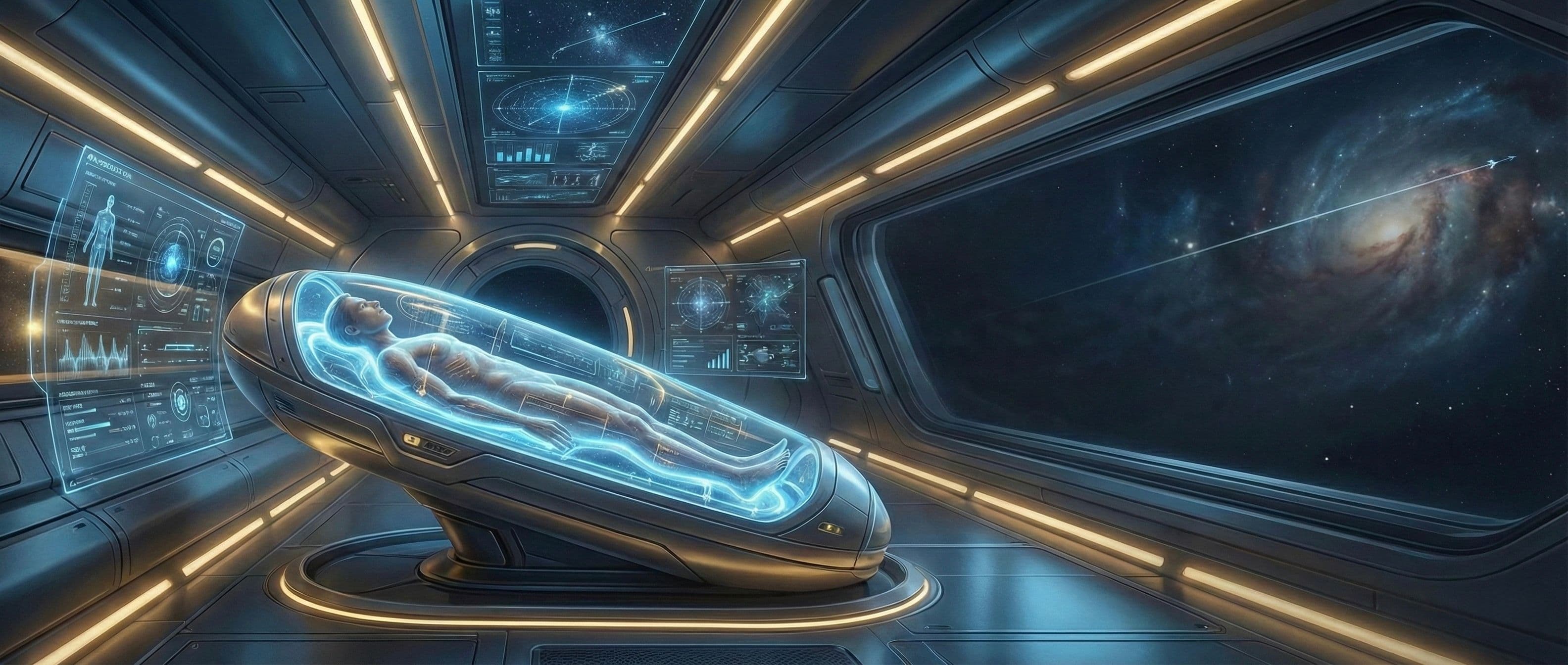
The fundamental tension of ultra-long-range transit lies not in the mechanical traversal of distance, but in the profound metabolic dissonance induced by the defiance of terrestrial rhythms. For the sovereign individual, the act of displacement across longitudinal boundaries introduces a systemic volatility—a fragmentation of the circadian apparatus that threatens the cognitive and cellular equilibrium. To command the Chronos Protocol is to reject the passive endurance of "jet lag" in favor of an active, architectural curation of one’s internal milieu. It is an assertion that the biological self shall not be subsumed by the friction of velocity, but rather maintained in a state of suspended physiological grace.
The vessel, in this context, ceases to be a mere instrument of carriage and becomes a localized atmospheric sanctuary. Sovereignty is achieved through the precise manipulation of environmental variables—spectral light composition, hyperbaric stabilization, and the molecular purity of the recycled air—to mirror a synthetic progression of time that honors the body’s endogenous requirements. This is the stealth-wealth of the biological: the ability to arrive at a destination not merely present, but fully integrated, having bypassed the cognitive erosion that typically characterizes the crossing of time zones. The preservation of the self is the ultimate luxury, requiring a rigorous adherence to protocols that prioritize cellular stasis over the ephemeral comforts of the journey.
The Entrainment of the Molecular Clock
The architecture of this sovereignty is predicated upon the science of entrainment—the synchronization of biological oscillators to an external cue. By choreographing the photonic environment within the cabin, one can simulate a bespoke solar cycle that pre-empts the destination’s temporal reality. This is not a matter of aesthetics, but of neurochemical governance. The deliberate modulation of blue-light suppression and infrared saturation dictates the ebb and flow of melatonin and cortisol, ensuring that the hormonal architecture remains resilient against the turbulence of displacement.
Furthermore, the Chronos Protocol extends to the precision of nutritional intake, where the timing and glycemic load of sustenance act as secondary zeitgebers. To consume is to inform the body of its position in time; therefore, the protocol demands a strategic fasting-refeeding cycle that aligns the metabolic engine with the intended cognitive horizon. Through this multifaceted approach, the transit is transformed from a period of biological decay into a disciplined exercise in preservation. One does not simply travel; one architects a seamless transition of the soul and its vessel through the void.