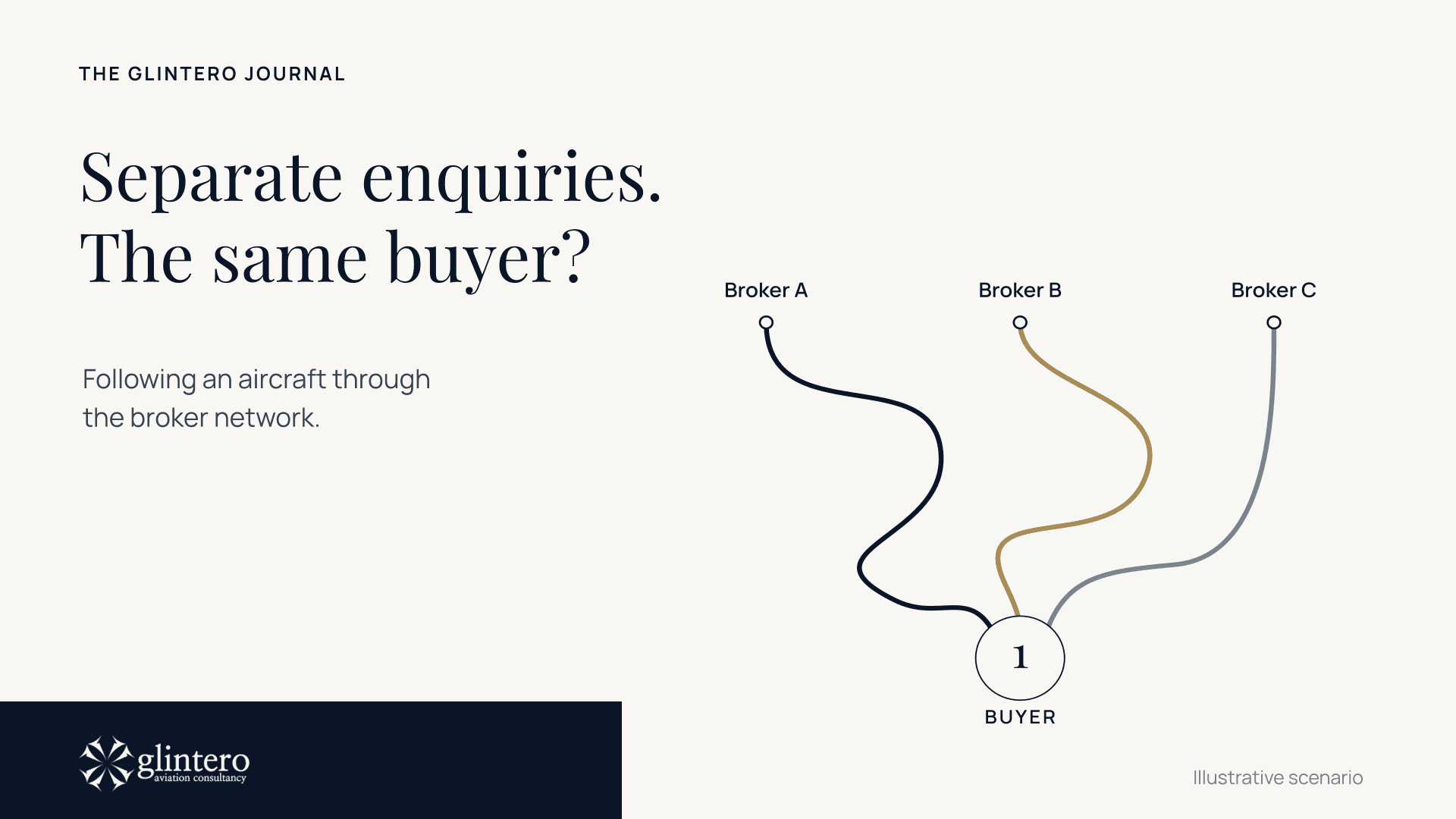
Several brokers contact an aircraft owner about a sale. Each says they have a buyer. They may all be speaking to the same person, whether directly, through another broker or through a relationship the owner cannot see.
That buyer may receive a different price through each route. The owner sees separate enquiries and may mistake them for competition between buyers. The buyer sees several ways to approach the same aircraft, with different information attached.
Before negotiating, establish who is considering the purchase, what each intermediary is authorised to do and where each price came from.
Otherwise, a concession made through one broker can return through another as a reason to reduce the price again. The owner may be negotiating several times with the same buyer without knowing it.
Understand the route to the buyer
A broker may represent the buyer directly, introduce another representative or be checking whether the aircraft suits an enquiry. A dealer may want to purchase as principal. Establish which role applies.
Who will make the purchase decision, and what access does the intermediary have to that person?
Ask whether the intermediary has discussed this aircraft with the buyer and can convey the buyer's instructions. Can they obtain decisions on price and terms or arrange a direct discussion when appropriate? Having the specification or the owner's telephone number establishes none of this.
Several intermediaries can have legitimate roles in a transaction. The objective is to understand those roles before treating each approach as evidence of a separate buyer.
Establish what the price represents
There may be no official asking price. A figure circulating between brokers could be the owner's earlier expectation, an intermediary's estimate, a proposed seller-net amount or a number someone believes would secure the aircraft.
Do not compare those numbers until their basis is clear. For each price, ask:
- Who provided it, and when?
- Has the owner authorised it to be communicated, and for what purpose?
- Is it an indication, a price being quoted to a buyer, or an offer received from one?
- What fees or commissions are included, and who is expected to pay them?
- What assumptions apply to maintenance, delivery condition, location and timing?
Different figures can make a buyer question whether the seller's position has changed, even when the owner authorised none of them. The difference may also reflect different dates or commercial assumptions. Ask for the explanation before drawing conclusions about anyone's conduct.
If the owner has chosen not to state an asking price, make that instruction explicit. Tell intermediaries whether they may discuss a range, invite offers or refer pricing questions to an agreed contact.
Check for overlap without exposing the buyer
Checking for duplicate enquiries should not require circulating a buyer's name across the broker network. That can damage relationships and disclose more than the enquiry requires.
Ask each intermediary whether the buyer has already reviewed the aircraft through another source and whether another adviser is involved. Record the answer and date. Similar mission requirements, geography or timing may suggest overlap; they cannot confirm it.
When overlap needs to be checked, agree a confidential route. With the relevant parties' permission, the buyer or its authorised representative can confirm the position privately to the owner's designated representative or counsel. Limit the information to what is needed to establish whether the enquiries concern the same buyer and which route that buyer wishes to use.
The purchasing entity's name may not settle the question if an acquisition vehicle is still being formed or several entities are under consideration. Clarify this through the same confidential channel.
Until the buying party can be verified, mark the enquiry as unresolved and exclude it from the confirmed count of independent buyers.
Separate enquiries from actionable proposals
An intermediary asking for the owner's lowest number provides limited evidence of demand. A buyer who has reviewed current information and can explain its proposed transaction gives the owner more to assess.
Request a short written summary: the aircraft, proposed purchasing party, representative's role, price and currency, main conditions, decision process and expected timetable. Where appropriate, agree how the buyer's ability to proceed will be verified confidentially.
Check the technical basis of the proposal. Prices may assume different treatment of an upcoming inspection, engine programme coverage, outstanding discrepancies or delivery condition. A changed technical basis can explain a changed proposal from the same buyer.
A written indication or letter of intent records a position. Review its conditions and status; the heading alone, like a forwarded price, cannot establish that the transaction will complete.
Keep one enquiry record
Keep an enquiry register accessible only to the people managing the transaction. For each approach, record the intermediary and stated role, buyer-verification status, source and date of the price, information supplied and next agreed step.
Use the same process for each enquiry:
- Acknowledge the enquiry and clarify representation before discussing concessions.
- Check for possible duplication through the agreed confidential route.
- Record the terms being discussed and any permission to circulate them.
- Route decisions and revised proposals through an agreed owner-side contact.
Once overlap is confirmed, agree how communication will continue. Review existing representation and fee arrangements before changing routes. Identifying the same buyer behind two enquiries does not settle those contractual arrangements.
Report what is known
Buyers may reasonably withhold their identity early on, while intermediaries may still be establishing their instructions. Keep those uncertainties visible in the owner's report.
Report the number of intermediary enquiries, which have been checked and whether the number of independent buyers is confirmed. The owner can then decide whether to wait, seek clarification or negotiate.
Before the next price discussion, check how many independent buying decisions have been established behind the enquiries.