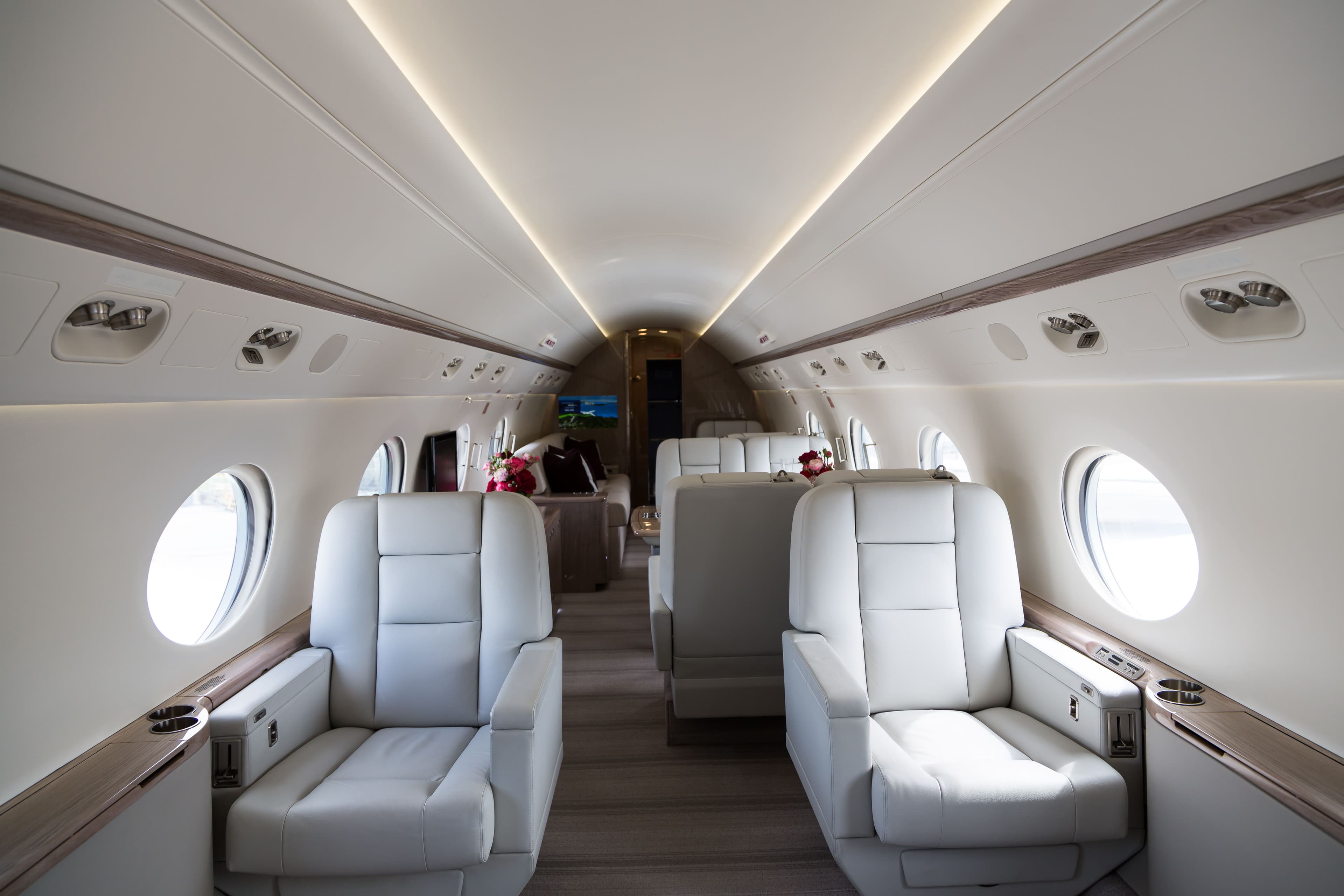
The pre-owned jet market in 2026 is not one market. It is two — and the difference between them is not aircraft size, not range, not manufacturer. It is supply position.
In one lane: aircraft with fewer than 5% of the active fleet for sale, buyers competing on short windows, and transaction prices near or above factory list. In the other lane: aging platforms with double-digit fleet percentages on the market, average days-on-market stretching past six months, and sellers cutting prices without generating interest.
If you are shopping pre-owned right now and not distinguishing between these two lanes, you are going to lose time, money, or both.
Where inventory is tight
The Bombardier Challenger 650 has roughly 3–5 examples publicly listed globally at any given time. Average days on market: 90–120 days. Asking prices range $19M to $35M for 2015–2020 models. Most transactions happen before a listing goes public. Buyers who wait for a Controller posting are already behind.
The Citation Latitude is tighter still. Approximately 6 units listed against a large installed fleet — roughly 1% of active aircraft for sale. The Praetor 600 sits at 4% of fleet listed, averaging $26.5M, and used examples have traded near or above Embraer's $22M factory list price because delivery slots and demand overlap.
The Gulfstream G650ER is the most extreme case: publicly, 2 examples listed. Add off-market inventory and you reach 10–15 total, but buyers for this aircraft operate through relationships, not listings. Average days on market for G650ER: 160 days. For a $40M+ aircraft, that is fast.
What connects these types: they are all modern, well-supported by manufacturer programs, and in genuine demand from operators who need range, cabin, and reliability without multi-year new-delivery lead times. Connectivity upgrades (Starlink, Ka-band) are already installed or straightforward retrofits. Engine programs are enrolled. No deferred surprises.
Where inventory is stuck
The Challenger 604 tells a different story. 15 units listed, another 4 under contract, 2 off-market. Several examples have been sitting 250–380+ days. Average asking price: $6.04M. For a 30-year-old platform with GE CF34 engines and increasingly costly C-checks, the buyer calculus is getting harder.
The Gulfstream G550 shows the same pattern. 37 units for sale at an average $23.1M — 6% of the active fleet. The trend line on 2003–2006 examples is clearly negative. These aircraft are hitting 192-month airframe inspections at $600K–$1.2M of shop cost, and unenrolled engines are adding 15–25% discounts before negotiations even start.
Days on market at 120–150 days for the G550 looks acceptable in isolation. Add 3–6 months of pre-purchase due diligence on an older example and the ownership clock doesn't start for nearly a year.
What is driving the split
Three factors separate the two lanes:
Program coverage. Aircraft enrolled in hourly-cost maintenance programs (RRCC, JSSI, MSP) transact faster and at better prices. Buyers are paying for certainty, not just hardware. An aircraft with full RRCC enrollment and a recent interior asks and usually gets a $1M–$3M premium over an unenrolled equivalent. The gap is not irrational — it represents real deferred cost shifted to the seller.
Connectivity. Ka-band and Starlink retrofits have moved from optional to expected in the large-cabin segment. Aircraft without modern connectivity sit. The G550 market confirms this: aircraft with JetWave or Starlink installations are the ones moving at 120 days. Without connectivity, add 60–90 days and a price reduction.
Fleet age and regulatory exposure. The FAA's CVR rule, extended overhaul intervals, and aging aircraft AD exposure are all accumulating simultaneously on platforms built in the early-to-mid 2000s. Buyers are pricing in that risk. On a $6M Challenger 604, a $500K engine shop visit is a 9% acquisition cost hit on top of a C-check.
What this means for buyers in 2026
If you are targeting a supply-constrained type — Challenger 650, Praetor 600, Citation Latitude, G650ER — work through relationships and move fast when something becomes available. These aircraft do not sit. Negotiating leverage is minimal. Pre-purchase inspection scope is still essential, but timeline pressure is real.
If you are considering an aging platform — G550 2005 vintage, Challenger 604, older Falcon 900 series — the leverage exists but the due diligence scope needs to match it. Price a full pre-buy with engine borescopes, landing gear inspection, and avionics assessment before making an offer. Budget the first 24 months of ownership cost including any deferred items. The acquisition price is the starting number, not the finish line.
The two-speed market rewards preparation. In the fast lane, buyers who arrive informed close. In the slow lane, buyers who shortcut due diligence inherit problems. Neither category is inherently wrong. The mistake is shopping in one lane while using the assumptions of the other.