Piaggio Avanti EVO: The Complete Buyer's Guide
The Short Version
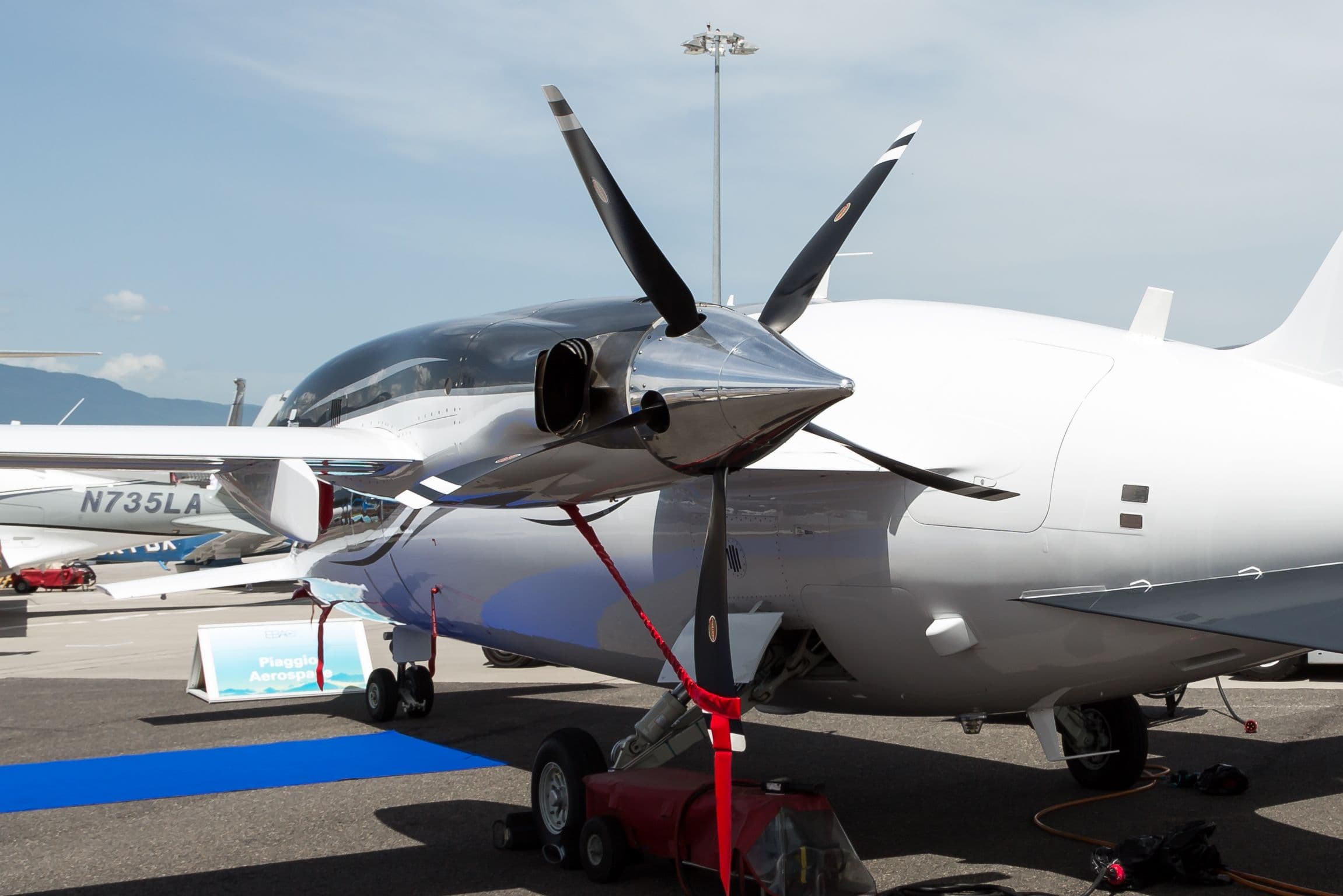
The Piaggio Avanti EVO is the only aircraft of its kind — a twin-turboprop pusher with three-blade props that looks like nothing else in the sky. Delivered from 2015, it carries 6-9 passengers across 1,520 nautical miles at 345 knots. Pre-owned examples range from $4M to $7M. The Avanti EVO is a niche aircraft for operators who value its unique combination of efficiency, cabin volume, and the undeniable conversation-starting design. It divides opinion — but those who love it, love it deeply.

At a Glance
Operational Reach

What Makes the Avanti EVO Different
1. The most distinctive aircraft in business aviation
The Avanti EVO is a pusher turboprop with a three-blade prop on each engine and a twin-boom fuselage design. It looks like nothing else in the sky. Beyond aesthetics, the design delivers real aerodynamic efficiency — the Avanti burns 30-40% less fuel than comparable jets at similar speeds, which translates directly to lower operating costs per nautical mile.
2. The widest cabin cross-section in its class
The Avanti EVO cabin is 6 ft 5 in wide — wider than the Citation Latitude (6 ft 8 in is close but the Avanti is a turboprop with a stand-up cabin throughout). The interior volume is comparable to some super-midsize jets. For operators who need cabin width for comfort or cargo, this is a significant advantage.
3. Turboprop efficiency and economics
At 345 knots cruise, the Avanti EVO is slower than jets — but fuel burn is 30-40% lower than a jet covering the same mission profile. For operators running regional routes of 2-4 hours where the speed differential with jets is modest (15-20 minutes), the Avanti offers meaningful operating cost advantages. The PT6A engines are also among the most reliable powerplants in aviation.
Who Is This Aircraft For?
- ●Operators running regional missions of 2-4 hours across Europe, Middle East, and Asia where the turboprop efficiency and wide cabin are more important than jet speeds.
- ●Buyers who value the Avanti EVO's unique design and are willing to accept the turboprop speed limitation in exchange for the lower operating costs and distinctive presence.
- ●Private operators who want the volume of a super-midsize but primarily fly short to mid-range legs — the Avanti EVO covers the mission at a fraction of the operating cost.
- ●Charter operators who fly routes where the Avanti EVO's efficiency translates to competitive pricing while still offering a wide, comfortable cabin.
When It's Not the Right Fit
- ●If you regularly need to fly legs over 2,000 NM, the Avanti EVO's 1,520 NM ceiling will require fuel stops. For those missions, a light jet (Citation CJ3+) or super-midsize (Latitude) is the better choice — even if the acquisition price is higher.
- ●Buyers who want jet speeds (Mach 0.70+) and don't value the turboprop efficiency trade-off. The Avanti EVO is slower than any jet in its class — if speed is the priority, look at the Latitude or CJ3+.
What It Costs to Own and Operate
Acquisition (Pre-Owned)
Annual Fixed Costs
Variable Costs

The Pre-Owned Market Right Now
Market research reviewed October 8, 2026. Figures below retain their source dates and measurement basis.
AIR.ONE displays a 2018 Avanti EVO in India at $6.5M with 1,222 total hours. The advertisement's maintenance narrative refers to work scheduled through August 22, 2025, so this is a currently displayed price reference with stale maintenance detail, rather than a newly verified ready-to-deliver offer.
Our reading: the public EVO sample is too sparse to calculate a defensible model-wide median, but the $6.5M advertised example gives a concrete budget anchor. Original P.180 and Avanti II offers should be kept out of an EVO-only price range. Location, import costs and updated engine/inspection records determine how directly this Indian offer compares with another aircraft.
What to Watch For When Buying
1. Piaggio support network is smaller than Cessna or Bombardier
With only 129 aircraft produced, the Avanti EVO support network is inherently smaller. Piaggio Aerospace's authorized service centers are fewer globally. Before purchasing, confirm there is a qualified maintenance provider within reasonable range of your base. Independent MROs with PT6 experience can support the engines but verify they have Avanti-specific training.
2. PT6A-66B engine condition and hot section status
The Pratt & Whitney Canada PT6A-66B engines are reliable and well-understood. However, hot section inspections (HSI) are required at prescribed intervals. Verify the engine LLP status, time since last HSI, and trend monitoring history. Aircraft approaching HSI without program coverage represent significant hidden liabilities. Enroll in P&W ESP immediately upon acquisition.
3. Propeller and reduction gearbox maintenance
The three-blade props and reduction gearboxes require specific maintenance attention. Verify the propeller condition, blade track, and gearbox oil analysis history. High-time propellers and gearboxes are expensive to overhaul. Confirm the maintenance history for these components specifically.
4. Limited pre-owned market liquidity
With only 2-4 aircraft typically available at any given time, the Avanti EVO pre-owned market has low liquidity. This means the spread between asking and transaction prices can be wide, and you may need to wait for the right aircraft to become available. If you need to sell quickly, this lack of liquidity works against you. Build this into your acquisition strategy.
5. ADS-B Out compliance
Verify ADS-B Out compliance for your target airspace. Late-model Avanti EVOs should be compliant from factory, but early-production models may require an upgrade. Confirm the transponder status before closing.
6. Interior condition and unique cabin materials
The Avanti EVO interior uses specific cabin materials and finishes that reflect the aircraft's Italian design heritage. A full refurbishment runs $200K-$400K and requires a facility with Avanti experience. Verify the interior condition carefully — original 2015-2018 interiors are now 7-10 years old and may need refreshing.
Avanti EVO vs. The Competition
| Aircraft | Range | Max Speed | Cabin W | Cabin L | Pax | New Price | Pre-Owned |
|---|---|---|---|---|---|---|---|
| Cessna Citation Latitude | 2,700 NM | Mach 0.80 | 6 ft 8 in | 28 ft | 9-10 | ~$22M (historical) | ~$9M (historical) |
| Embraer Phenom 300E | 3,650 NM | Mach 0.78 | 5 ft 1 in | 17 ft 2 in | 10-12 | ~$11M (historical) | ~$5M (historical) |
| Pilatus PC-12 NGX | 1,843 NM | Mach 0.52 | 5 ft 8 in | 22 ft 4 in | 9-11 | ~$10M (historical) | ~$5M (historical) |
Cessna Citation Latitude
Embraer Phenom 300E
Pilatus PC-12 NGX
vs. Cessna Citation Latitude
The Citation Latitude is a jet (not turboprop) with significantly more range (2,700 vs 1,520 NM), higher cruise speed (Mach 0.80 vs Mach 0.52), and a longer cabin. However, it costs more to acquire ($9M vs $4M-$7M for an Avanti EVO) and operates at higher cost per hour. The Avanti EVO wins on acquisition price and operating economics; the Latitude wins on speed and range.
vs. Embraer Phenom 300E
The Phenom 300E is a jet with more range (3,650 NM), significantly higher cruise speed (Mach 0.78), and a larger cabin volume. Pre-owned prices overlap with the Avanti EVO. The Avanti EVO wins on cabin width (6 ft 5 in vs 5 ft 1 in); the Phenom wins on speed, range, and pre-owned availability.
vs. Pilatus PC-12 NGX
The PC-12 NGX is the Avanti EVO's closest competitor — both are turbine-powered, both burn Jet-A, and both share similar cruise speeds. The PC-12 has a longer cabin (22 ft vs 17 ft) but narrower (5 ft 8 in vs 6 ft 5 in). The Avanti EVO wins on speed and cabin width; the PC-12 wins on cabin length and passenger capacity.
Looking for a Avanti EVO? Let's talk.
Many aircraft change hands privately. Tell us your requirements and we will source off-market options.
Source a Avanti EVO →Frequently Asked Questions
1,520 nautical miles at normal cruise (345 knots) with 4 passengers and IFR reserves. That covers routes like London to Dubai (with a fuel stop), New York to Miami, or Dubai to Nairobi. At long-range cruise settings, the range can extend to approximately 1,700 NM.
Reviewed October 8, 2026: $6.5M asking — 2018 Indian example. This describes the dated public sample or position identified in the market overview, rather than a price for every aircraft of this model. The market overview links the source and explains the sample.
Historical planning estimate; obtain current aircraft-specific pricing. Variable operating costs run approximately $1,170-$1,300 per flight hour — significantly lower than jets covering similar missions due to the turboprop's lower fuel consumption.
The pusher configuration — with propellers at the rear of each engine nacelle — allows the wing to be placed further forward, optimizing the aerodynamic layout. It also means the propeller noise is directed away from the cabin, creating a quieter interior than many turboprop competitors. The three-blade props are iconic and contribute to the distinctive look.
Yes. At 345 knots, the Avanti EVO is faster than the Pilatus PC-12 NGX (285 knots), King Air 250 (265 knots), and most other turboprop competitors. It is the fastest turboprop in its class. The trade-off is range — the Avanti EVO has less range than the PC-12 NGX (1,520 vs 1,843 NM).
Yes. Piaggio Aerospace continues to produce the Avanti EVO. However, production rates are low and there is a backlog. Pre-owned is the most practical acquisition route for most buyers given the thin new aircraft pipeline.
Free Avanti EVO
Market Report
Get current pricing, active listings, price trends, and Glintero's read on where the Avanti EVO market stands right now. Delivered to your inbox.
- ✦Current asking prices & 12-month trend
- ✦How many are for sale right now
- ✦Representative listings (sanitized)
- ✦What drives value for this type
Free. No pitch. Just data.
Considering a Avanti EVO?
No pitch, no pressure. Just twenty years of experience and a straightforward conversation about what fits your mission.
Initiate Private ConsultationLast updated: 2026-10-08